Being Non-Binary in a Binary World (Blog)
Introduction
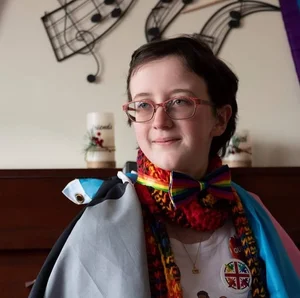
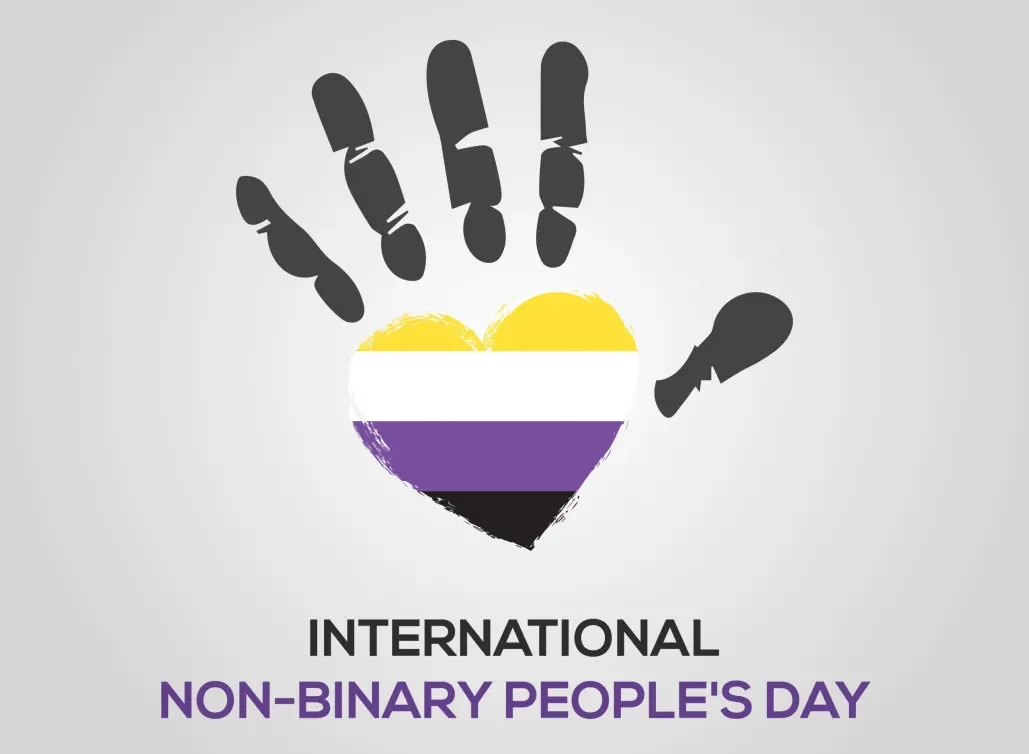
Today, July 14, is International Non-Binary People’s Day. This day was chosen because it sits exactly between International Women’s Day (March 8) and International Men’s Day (November 19). This day is an opportunity to celebrate non-binary people, raise awareness about issues facing non-binary folks, and commit to working to challenge binaries in all their forms. As a non-binary person, I wanted to take this opportunity to share some about my experiences and my story of what it means to be non-binary in a binary world.
What Does It Mean To Be Non-Binary?
Non-Binary as a term can mean different things to different people. It’s unique for me and for every non-binary person!
Non-Binary Is An Umbrella Term
Non-binary refers to people whose sense of gender does not fall exclusively into the binary genders of “woman” and “man”. This is an umbrella term that references people whose experience of gender is outside of the binary – many additional terms fall under this umbrella. This can include people whose experience of gender could include…
Feeling both feminine and masculine, and/or androgynous (androgyne)
Falling somewhere between woman and man (intergender)
Having a partial connection to a gender (demigirl, demiboy, demigender)
Being multiple genders (bigender, trigender, pangender)
Feeling entirely neutral, or more like a person than a particular gender (gender neutral, gender nonconforming, agender)
Having a fluid sense of gender, either in the gender itself or the intensity of the experience of gender (genderfluid, genderflux)
In this way, non-binary means different things to different people. Non-binary does fall under the trans umbrella, so some non-binary folks may use both non-binary and trans, whereas some non-binary folks do not consider themselves to be trans. However non-binary people experience and refer to their gender(s), they are valid and deserve to be respected.
My Journey of Being Non-Binary
I have always felt extremely neutral, even as a kid. Growing up, I was often called a “tomboy” because I was never really interested in things that were assigned/assumed to be super feminine/girly (I didn’t like the colour pink or playing with dolls). I tended to gravitate towards more masculine or gender-neutral things in terms of colours and toys that I played with. I also never really felt that I fit into what society taught was a “girl” or a “boy”, often seeing myself as a mix of both, or none of the above.
I was 14 years old when I first discovered what it meant to be non-binary. I was chatting with a friend “E” about our mutual friend “I”, and accidentally misgendered “I” as I’d previously not known “I’s” pronouns. “E” corrected me, saying “they use they/them pronouns”. I remember feeling slightly surprised and confused, but mostly excited, thinking to myself – that’s an option?
It took another three years before I came out as non-binary, though I came out as a lesbian at 15. First I considered myself to be gender fluid, because it felt like my sense of gender was changing. In reality, I was asking people to use different pronouns and gendered language based on what felt the least horrible in the moment, because at the time I still felt limited to she, he, or they (feminine, masculine, androgynous). After a couple of years, I realized my sense of gender wasn’t fluid, but that I was solidly feeling neutral, so I ended up using the term non-binary.
Today, the term that best describes my gender is neutroisflux. This means that I always feel neutral (neutrois), in that my gender is never associated with the binary. However, the intensity of that fluctuates (flux). Essentially, some days I feel very intensely that yes, I do have a gender – it is a third gender outside the binary (non-binary). Other days, I don’t feel like I have a gender at all, that I want people to just see me as a person rather than associated with a particular gender (agender). In casual conversation, I mostly refer to myself as non-binary, sometimes agender, because that seems to be more commonly understood (though is still often misunderstood).
Pronouns and Language
For many of us in the non-binary community, finding pronouns and language that affirms us can be challenging. Now, for some non-binary folks, they are comfortable with some/all feminine or masculine language, which is totally valid. But for many of us, that is not the case. That’s why it’s super important to check in with non-binary folks in your life to find out what feels affirming for them!
I mainly used they/them pronouns for a while, because those were the only pronouns I was really aware of. And they/them was okay – it didn’t cause feelings of dysphoria like she/her or he/him did for me. But around when I turned 20, I couldn’t help but wonder if I could find a pronoun that actually made me feel good and happy, rather than just “okay”. That’s when I discovered neopronouns, and selected ney/nem pronouns. I’ve written more extensively about my pronouns in this blog. I particularly love ney/nem pronouns because the “n” stands for “neutral”, which very much resonates with my experience of gender. When people use the correct pronouns for me, it’s like I’m laying on my bed with my cat Natasha (she/her) purring on top of me, wrapped in my fuzzy blanket – it is the most warm, comforting, validating experience because I feel seen.
Just as it took some time to find the correct pronouns for me, it took some time to find language that felt comfortable and neutral. For instance, I really like the following:
Gender neutral greetings like “folks”, “siblings”, “comrades”, “friends”
Gender neutral terms within the family setting such as “sprog” (rather than daughter/son/child) and “sibkid” (rather than niece/nephew)
Gender neutral compliments such as “fabulous”, “attractive”, “breathtaking”
When people intentionally are using gender neutral language, and (more importantly) checking in with me about what feels good, it is incredibly affirming and again, makes me feel seen.
Challenges Faced by Non-Binary People
Non-Binary people live in a world that is, inherently, binary. Our world likes to categorize everything into so-called “opposites” – happy/sad, good/bad, healthy/unhealthy, black/white, protagonist/villain, gay/straight, woman/man. Many of us (not just non-binary people!), exist in the in-between and outside of these binaries. This can lead to many challenges, especially for those of us who are non-binary in our gender.
Myths & Microaggressions About Non-Binary People
Microaggressions are defined as the everyday, subtle, intentional — and oftentimes unintentional — interactions or behaviors that communicate some sort of bias toward members of equity-deserving communities. I have written more extensively about the harms of microaggressions in this blog, but here I want to address examples of common microaggressions towards non-binary people that I have been on the receiving end of. Importantly, each of these are related to harmful myths about non-binary people.
“Being non-binary is like, super trendy right now.”
The gender binary has always existed, and there are examples of people outside of the gender binary in cultures and communities around the world. Colonization and white supremacy instituted the gender binary and harsh punishment for those who cannot and do not conform. Despite this, non-binary people can and do thrive in their cultures and communities.
“Non-binary isn’t a real thing. There’s either man or woman, period.”
The assumption that there is only man or woman is rooted with the gender binary, and also the assumption that our gender matches our sex assigned at birth. This also assumes that sex/gender is binary, which is false. In reality, intersex people exist (so sex is not binary), and gender is a biopsychosocial phenomenon, in which many of us break and challenge biopsychosocial constructions of gender and binariness.
You don’t look non-binary.”
The idea that someone should “look non-binary” is highly problematic. First and foremost, most people wouldn’t look at someone and assume “that’s a non-binary” like we would assume “that’s a woman” or “that’s a man”. Second, even if those assumptions are made, this is often due to the myth that non-binary people must present as “androgynous” (i.e. mix of feminine/masculine). However, non-binary people do not all present as androgynous. Being non-binary means different things for each of us – some non-binary people may not change their appearance whatsoever, some might do some or all medical transition, some may socially transition. All non-binary people are valid.
The prevalence of these myths and microaggressions are particularly harmful because those of us who are non-binary often face this in multiple spaces and regularly – at school, work, with friends, family, in public, and sometimes with complete strangers. This leads to us often feeling like we constantly have to “prove” ourselves as non-binary, while simultaneously being invalidated and disrespected for who we are.
Navigating Binary & Gendered Spaces
Bathrooms are a constant issue, because most washrooms are gendered. For me as a non-binary person, I don’t feel safe in a “men’s” washroom, and I feel uncomfortable and somewhat dysphoric in a “women’s” washroom. Thus, gender neutral washrooms are the best option, but these are often non-existent. What is particularly frustrating is when I go to a restaurant, cafe, or other location and there are two washrooms – both single-stalled and the exact same – that have a gendered sign on it. It is extremely unnecessary, and incredibly exclusionary. I shouldn’t have to think about whether there's going to be a washroom where I feel safe and comfortable, but I constantly deal with this anytime I go out in public.
Similarly, there are a lot of other spaces in our society that are gendered. For instance, some choirs still use the language of “women’s” and “men’s” sections, rather than referring to the voice part (soprano, bass) or upper/lower designation. Some support groups and community spaces are particularly geared towards only women, or only men. Similarly, some events may say they are for “women and non-binary people”, but this also doesn’t feel great because it’s the assumption that non-binary people are just “women-lite”. When we can remove gender designations altogether, that is also great. Ultimately, it can be extremely frustrating to have to constantly figure out if I can authentically show up as a non-binary person in spaces that are often highly gendered.
The other significant challenge that non-binary folks can experience is in relation to transition. Much of our society assumes that transition is from “one to the other” (i.e. “woman to man” or “man to woman”). There’s almost a set checklist for trans men and trans women, where you do the social transition, then legal, then medical (hormones then top then bottom surgery). For those of us who are non-binary, that is not the case – this is also not always the case for trans men and trans women, showing how binaries are harmful for all of us! Transition is a deeply personal process and can look different for different people. For some, they don’t feel the need to transition and that is valid. For others, they may use any combination of available transition options – changing name, pronouns, language, appearance (clothing, hairstyle), legal documentation, hormones, surgery, reproductive organs, medications, voice, etc. Some may do a couple of these, some may do all, and everything in between. However, those of us who are non-binary are more likely to be assumed to not want to transition (because of binary assumptions), and to be limited access to transition by medical professionals because we don’t “fit” their assumptions of what it means to be trans. This makes it very difficult for us to find what we need to live authentically and feel at home as ourselves and in our bodies.
Dealing With Misgendering
Misgendering can be constant, and is deeply painful. An academic study found that:
59% of non-binary people are misgendered daily and 30% are misgendered weekly or monthly. This means that 89% of non-binary people are regularly misgendered.
Of those who are regularly misgendered, 58% report that they are “very” or “quite” upset.
Only 1 in 8 regularly correct those who misgender them.
Two years ago, I conducted a self study where I noted the different pronouns and language that people used in reference to me over the course of four months. The wrong pronouns for me were used 57% of the time, particularly in family and professional settings. Meanwhile, 84% of the time feminine language (e.g. “ladies”, “ma’am”, “girl”) was used in reference to me.
Misgendering is inherently harmful. It is disrespectful, and it tells us (as non-binary people) that you don’t see us for who we are. It says:
“I’m okay with hurting you.”
“You’re not the expert on yourself – I know you better.”
“I’m okay with teaching everyone around me to disrespect you.”
“You/your pronouns are an inconvenience.”
“Your safety does not matter to me.”
“I’m not willing to put in the work to be an actual ally.”
When misgendering constantly happens, this is usually because someone is not doing enough to learn the person’s pronouns (i.e. practicing), or they are doing so to show deliberate disrespect or disregard. The intent does not matter as much as the impact – even if you don’t intend to misgender, even if you don’t intend to cause harm, it does cause harm. Misgendering is harmful. It’s not an annoyance. It’s not a simple mistake. It is harmful, which makes it even more critical for us to work to reduce that harm by reducing our misgendering.
What is Solidarity With Non-Binary Communities?
There are small, tangible, easy ways that we can show support to and solidarity with non-binary communities, while working to build more inclusive spaces for everyone.
Using Inclusive Language & Correct Pronouns/Name
Gender neutral language and respecting people’s pronouns (and name) is the minimum way that we show respect for non-binary people. This includes learning to use the correct pronouns, even (and especially) if these are pronouns that you are less familiar with, such as mixed or neopronouns. Here are some things you can do:
Read “A Pocket Guide to Pronouns” to learn more about different pronouns and what to do if you make a mistake
Use resources such as Practice with Pronouns and Pronoun Dressing Room to practice using different types of pronouns
Find examples of gender-neutral family terms that might resonate with non-binary family members, and ask what they want you to use!
Try out different gender neutral greetings like “friends” and folks
Of course, even with practice, we can make mistakes. How you react with a mistake is critical. Don’t make it about you, don’t try to justify your mistake, and don’t pretend it doesn’t matter. Instead, correct yourself with the right language/pronoun/name, correct others if/when they make a mistake, and accept corrections with grace and appreciation. You don’t have to be perfect, but we want to see that you’re trying – because that tells us that you care about us and see us for who we are, as non-binary people.
Challenging Binary and Gendered Spaces
If you notice instances of binary spaces in your day-to-day life, you can invite the leader(s) into conversation about being more intentional about including non-binary people. This can include:
If you notice a space has single-stall washrooms that are gendered, ask if the gendered signs can be removed, and instead just refer to “washroom”
If you notice instances of gendered language and spaces (e.g. “women’s choir”, “men’s golf club”), ask about possibilities for trans inclusion and non-gendered spaces
Be conscious of avoiding just using “women and non-binary”. Instead, consider the meaning of the event, and explore language such as: “those with lived experience of gender-based violence”, “those who have experienced patriarchal oppression”, “women and marginalized genders”.
If your insurance company has options for gender affirming care, make sure these are not limited to trans men and trans women (e.g. you can only get “x” surgery if you have “x”).
Challenging binary and gendered spaces is a great way to be an ally. As non-binary people, it can be exhausting to constantly deal with gendered and binary spaces, and we often don’t necessarily want to get into conversation with folks about the harms of this, both because it is emotional labour and because sometimes we aren’t safe to do so. This is where you can effectively step up and advocate.
Learning From Non-Binary People
As with any kind of solidarity, it is critical that we are working for and with the community most directly impacted. Thus, your allyship and solidarity work should be informed and guided by the perspectives of non-binary people. Take time to learn from non-binary people about their stories and experiences!
My recommended non-fiction books are:
Beyond the Gender Binary (Alok Vaid-Menon)
Life Isn’t Binary: On Being Both, Beyond, and In-Between (Meg-John Barker & Alex Iantaffi)
None of the Above: Reflections on Life Beyond the Binary (Travis Alabanza)
Non-Binary Lives: An Anthology of Intersecting Identities (Jos Twist, Ben Vincent, Meg-John Barker & Kat Gupta)
My recommended fiction books featuring non-binary characters are:
I Wish You All the Best (Mason Deaver)
Lakelore (Anna-Marie McLemore)
The Bruising of Qilwa (Naseem Jamnia)
Bianca Torre is Afraid of Everything (Justine Pucella Williams)
You can also check out this video: 5 Non-Binary People Explain What “Non-Binary” Means To Them.
Conclusion
Learning is a continual journey. As a non-binary person, I am constantly learning – about new language, new pronouns, new genders, and new ways of being. We can all do this too. We can challenge binaries and assumptions that society places on us, instead working to create our own self-understanding. We can build spaces where everyone is free to be their full, authentic selves. And we can live more true into who each of us are, outside of binaries.