An Open Letter on Coming Out
There can be a lot of misconceptions on what it means to “come out”. Some people view this as telling everyone in your life that you’re queer, making a big social media post, maybe throwing something akin to a “gender-reveal party” (a.k.a. Queer reveal party). For some people, those certainly can be part of the steps of “coming out”. But coming out always starts with coming out to ourselves first, and finding the term(s) that feel right for us.
As a kid, I didn’t really have access to the terminology of the queer and trans community. I knew that girls could love girls and boys could love boys, and that was perfectly normal. I was also what many would consider to be a “tomboy” I was very fortunate to be raised in such an accepting household. Yet, because the specific terms like “gay” or “lesbian” or “trans” weren’t really part of my vocabulary, I didn’t have access to important resources that would have been helpful as a kid.
When I was 11 years old, I was outed to my school as a lesbian. “Outing” is when someone else discloses a person’s queer identity without their knowledge or consent. In my instance, when a girl in my class found out I wasn’t interested in dancing with boys, she told the school that I was a lesbian. I dealt with extreme homophobic bullying over the next two years, and ultimately left the school for my safety. This was when I first started learning both queer terminology, and the danger associated with these. For the first time, I ended up in the “closet”. After transferring schools, I hid my queerness and made every effort to “fit in” to cisheteronormative culture. This continued for two years, but led to intense feelings of anxiety (from worrying about being outed again) and lowered self esteem because I wasn’t able to be my authentic self.
In my early teens, I was fortunate for many reasons. For one, my parents had always been very accepting of me. The second reason is that I attended an arts school, Walkerville, which is well known for being a queer-friendly school. The third reason is that much of my friend group was on their own journeys of understanding gender and sexuality, and began to come out. Each of these factors gave me the courage to “come out” for real this time.
I was almost 16 when I had what I would consider my “official” coming out as queer. I had had a friend sleep over to celebrate New Years, and I asked her out. She said yes, and we had our first kiss at midnight (it was very cute). The relationship didn’t last, but I’ll always look fondly on the time I spent with her. The next morning, after she’d left, I told my parents that she was my girlfriend. My mom replied: “Okay, no more sleepovers with her!”. That led to some fun conversations with my parents and I about who could sleep over during the rest of my teen years!
Initially I came out as a lesbian, though I explored many terms under the queer umbrella. Today, I understand my sexuality as being asexual (meaning I don’t experience sexual attraction), and biromantic (I am romantically attracted to women and nonbinary folks). I most often use “queer” as an umbrella term and because most people have a general understanding of what it means; also, not everyone needs to know the intricate details of my sexuality and I don’t always feel like sharing!
Gender was a bit of a different journey. Like most people, I was raised in a society that heavily enforces the gender binary. Despite this, even as a kid I always had a strong sense of being neutral, that neither “girl” nor “boy” really fit me. I didn’t have the words for it until I was around 17 years old, when I had watched a close friend come out as a trans boy and start to transition, and several friends started to use they/them pronouns. Once I knew that other people felt this way, it was like a new world opened up to me.
Initially, I came out as gender fluid, because I felt like my sense of gender would fluctuate. I asked people to use different pronouns for me on different days based on which felt the least horrible (at the time, I was only using she, he, or they). I started experimenting with my gender presentation, including going to short hair, dyeing my hair rainbow, and eventually getting some tattoos. I did keep my birth name, because I really like “Sydney” as it is very androgynous and feels like it captures who I am as a person.
Around the age of 20, after switching to exclusively using they/them pronouns for a couple of years, I realized that something still didn’t feel quite right. I felt like they/them pronouns wasn’t really capturing who I was, so I started exploring neopronouns. I ended up selecting ney/nem pronouns because the “n” stands for neutral. When I first read that, it was like a fire lit in me – finally something that felt like it actually represented me. I ended up experiencing another “coming out” when I asked my friends on Trans Day of Visibility in 2020 to use ney/nem pronouns for me.
Along with the switch in pronouns came an increased understanding of my gender. The term that most accurately captures my sense of gender is “neutroisflux”. This means that I always feel neutral (neutrois), but the intensity of that fluctuates – sometimes I feel very intensely that I have a neutral gender, whereas other times I don’t feel like I have a gender at all, and just want to be seen as a person. I most commonly use “trans” and “nonbinary” to describe my gender because both of these do fit, and are more understood within our society.
Cishet people often see coming out as this one-time event, where you pick one term and stick with it and it happens once and that’s it. That’s rarely the case, as you can see in my story. It’s true that some people may stick with the term that they first come out as – maybe they first come out as pansexual and that works for them. That’s wonderful! But for many of us, it’s a continual journey, an exploration, deep thought and reflection about who we are as humans and who we are and aren’t attracted to. Just because we may change the term(s) that we use doesn’t invalidate what we used before – initially coming out as a lesbian worked for me at the age of 15, and it doesn’t work now. Similarly, the clothes that I wore at the age of 15 don’t fit me anymore, because people can change, and learn, and grow, and that’s totally normal. It’s all part of being human!
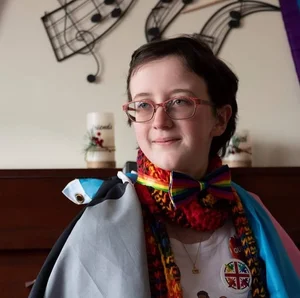
Coming out also usually isn’t a one-time thing. Instead, many of us are coming out over and over again in order to be seen and respected as our identity. This isn’t the desire for all queer people – some prefer to keep this more private, to go more “stealth” and that’s valid. But for some of us, we want to be seen as queer. We want to be acknowledged and celebrated for all parts of who we are. I choose to be visibly and aggressively queer – if you encounter me in a shop or in public you will see Pride buttons on my bag and some type of Pride bracelet or necklace. I also often wear Pride and protest-themed shirts to make it clear my social justice stance. If you walk into my home you will be greeted with a wall of Pride flags and art made by queer artists. I intentionally have my pronouns everywhere (when I wear a nametag, on my socials and email addresses, on virtual calls). I choose to be visibly queer because this is something that I want to share with other people, that I take great Pride in, and because I know the importance of visibility and representation especially for folks who can’t or don’t want to be visible.
With that said, it can also be exhausting to constantly come out, to have to evaluate if it is a safe space for us to be our authentic selves, and to be in a space where perhaps we can’t be “out”. This is why it’s super critical for cishet folks to be visible allies – to do all the things like wear Pride buttons, have signs in their offices, share their pronouns, use inclusive language for partners. The more that all of us can be visible, the safer spaces we can create.
So, on this National Coming Out Day, I want to extend my love to all my queer siblings. Wherever you may be on your journey, however you may understand yourself, whether you are “out” or not or somewhere in between, you are valid. You are part of a beautiful community. And you deserve to be honoured and celebrated for the fullness of who you are.
And to the allies – continue to show up. Make it clear that you are an ally through your actions. Reach out to and support your queer loved ones. Take time to explore your own gender and sexuality, even if at the end you conclude that you’re cishet! Every small step makes a big difference in creating a world for all of us to be our beautiful, authentic selves.